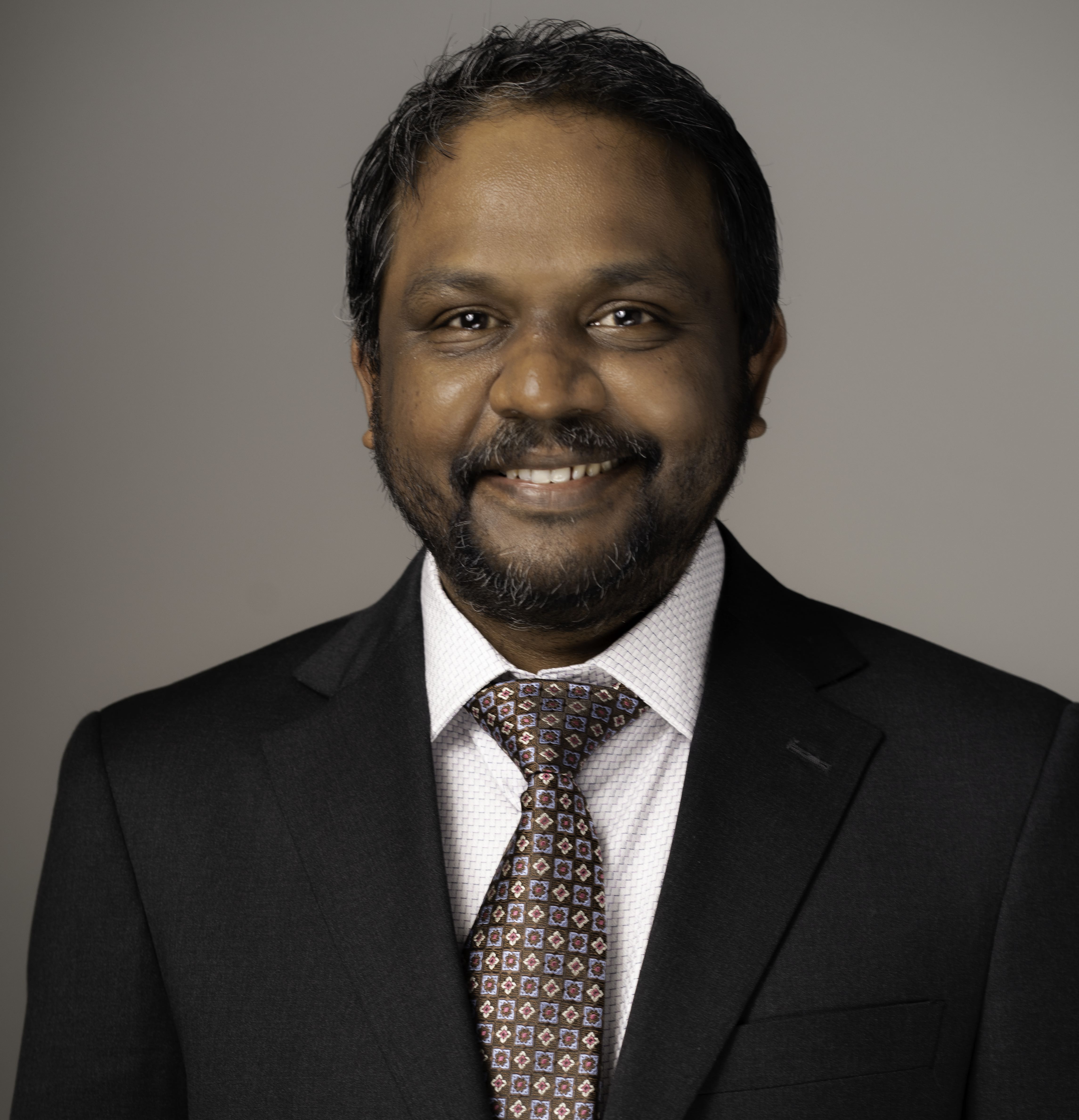
Anup Das, Ph.D.

(He/Him)

Associate Professor
Associate Department Head for Graduate Affairs
Department of Electrical and Computer Engineering
Director, Distributed, Intelligent and Scalable Computing (DISCO) Lab
Drexel University

Hello! I am an Associate Professor in the department of Electrical and Computer Engineering at Drexel University. I direct the Distributed, Intelligent and Scalable Computing (DISCO) Lab. I received a PhD in Embedded Systems from National University of Singapore in 2014. I have been a researcher in the Neuromorphic Computing Group of IMEC, Netherlands (2015 - 2017) and a post-doctoral fellow in the School of Electronics and Computer Science (ECS) at the University of Southampton, UK (2014 - 2015). Between 2004 and 2011, I have worked at LSI Corporation and STMicroelectronics, as senior IC design engineer.

My research interest is in hardware-software co-design for neuromorphic and in-memory/near-memory computing. I am a Senior Member of the IEEE and a Member of the ACM.

Selected Publications:

NEWRobust Hopfield Decision Transformer (NeurIPS 2026, to appear)

NEWAgatha: Gated Hopfield Attention for Adversarially Robust Natural Language Processing (EMNLP 2026, to appear) [GitHub Code]

Robertha: Eigenspectrum Regularized Attention for Robust Natural Language Understanding (ACL 2026)

Sparse Compressed Quantized Dataflow Architecture (QUDA) for Neuromorphic Computing (FCCM 2026)

Education.

Research.

Improving Robustness of Language Models

In this project, we are making language models robust to corrupted and adversarial inputs by rebuilding attention on Modern Hopfield Networks.

Language models are surprisingly fragile: uniform corruption of word embeddings hurts low-magnitude embeddings the most, and many of the words that carry grammatical and semantic structure live in that low-norm space. In Robertha, we replace standard attention with a Modern Hopfield mechanism in which semantic patterns act as attractors that pull corrupted embeddings back toward their correct representations. Heavily corrupted embeddings are refined over more iterations than lightly corrupted ones, and Eigenspectrum Regularization shapes the keys into strong, well-separated attractors with wide recovery basins. Across 13 GLUE and SuperGLUE tasks, Robertha outperforms existing robustness methods while keeping competitive clean performance. In Agatha, we target adversarial attacks with a drop-in change to the Transformer encoder: iterative Hopfield attention combined with a gated residual connection that forces adversarial gradients through the energy landscape, where they are contracted layer by layer, without adversarial training. We are now carrying these ideas into sequential decision-making with the Robust Hopfield Decision Transformer. [Robertha, ACL 2026][Agatha, EMNLP 2026][code]

Developing Spike-based Language Models

In this project, we are developing language models that compute with spikes, bringing the efficiency of the brain to natural language processing.

The attractor dynamics behind Robertha and Agatha come from Hopfield networks, a classic model of associative memory in the brain. We are building on this connection to develop language models whose attention and memory retrieval run as sparse, event-driven spiking dynamics instead of dense matrix products, aiming for models that are both robust and energy efficient. Our first steps include spiking neural networks for language tasks such as aspect term extraction. [paper]

Neuromorphic Computing

In this project, we are designing neuromorphic hardware for language model inference on the edge.

Running language models on edge devices calls for hardware that exploits sparsity, low precision, and event-driven computation while minimizing data movement. We design and prototype neuromorphic accelerators on FPGA along these lines: QUDA, a sparse, compressed, quantized dataflow architecture; sparse hashing to reduce the memory latency and bandwidth of spiking neural network accelerators; and QUANTISENC, a fully configurable many-core neuromorphic hardware design. Our goal is to run robust, spike-based language models on low-power edge platforms. [QUDA, FCCM 2026][ICCAD 2025][code]

Publications.

Title: NEWRobust Hopfield Decision Transformer

Authors: A. Podasca and A. Das

Conference: Conference on Neural Information Processing Systems (NeurIPS)

Date: 2026 (to appear)

Title: NEWAgatha: Gated Hopfield Attention for Adversarially Robust Natural Language Processing

Authors: A. Podasca and A. Das

Conference: Conference on Empirical Methods in Natural Language Processing (EMNLP)

Date: 2026 (to appear)

Title: Robertha: Eigenspectrum Regularized Attention for Robust Natural Language Understanding

Authors: A. Podasca and A. Das

Conference: Annual Meeting of the Association for Computational Linguistics (ACL)

Date: 2026

Title: Sparse Compressed Quantized Dataflow Architecture (QUDA) for Neuromorphic Computing

Authors: S. Matinizadeh and A. Das

Conference: IEEE International Symposium on Field-Programmable Custom Computing Machines (FCCM)

Date: 2026

Contact.

anup(dot)das(at)drexel(dot)edu (215) 895 2847
  • DISCO Lab,
  • Electrical and Computer Engineering Department,
  • Drexel University
  • 3101 Market Street, Suite 236,
  • Philadelphia, PA 19104, USA

The best way to reach me is by email:

anup(dot)das(at)drexel(dot)edu